Part 1
A. Title and Project Intent
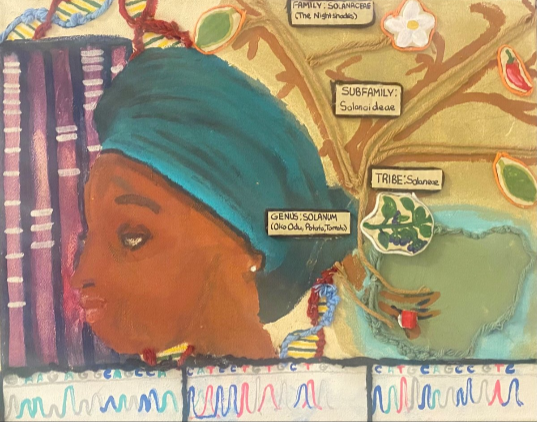
My IBAT final project, Ebí Mi, explores my Nigerian identity in the lens of biological systems: specifically through the taxonomic family of Solanum, the plant genus my ancestors in Ikorodu, Lagos cultivated for generations. The reason I went for this project is because I was drawn to this intersection because identity has never felt singular or fixed to me. It is a concept that feels layered, shaped by culture, land, ancestry, and biology all at once. By using the taxonomic tree as a structural device felt right because it does what identity does: it shows relationship, lineage, and branching without erasing where things come from.
The composition centers on a painted self-portrait surrounded by biological elements: a punch needled embroidered DNA double helix, a gel electrophoresis strip, my personal DNA chromatogram across the bottom panels, and a painted taxonomic tree mapping Solanaceae down to the specific plant my ancestors grew: Solanum aethiopicum, the African garden egg, known in Yoruba as Oko Odu. These aspects were not just decorative additions; each element is doing scientific and cultural work simultaneously.
My personal goal for the viewer is not immediate comprehension of my piece but rather a genuine engagement, the experience of noticing how things connect. I want someone to spend time with the piece and leave understanding, even viscerally, that identity is not a fixed thing. It is a system. Knowing that there are roots present.
B. Project Process (Beginning to End)
Near the beginning of this project, my initial idea was to create a 5×5 grid of canvases that formed a fragmented self-portrait, where each section would represent a different biological or cultural component of identity, and the viewer would mentally reconstruct the whole. I was interested in this idea because it visually represented fragmentation and complexity.
However, once I began working with punch needle techniques, I came across major issues that dealt with the structure, as the smaller canvases (made with cotton) were not strong enough to support the fabric tension required, making the material difficult to work with and unstable. Due to this, I shifted my approach to a single 16×20 fabric-based canvas, which allowed for better control and durability.
Throughout the process of my piece, I experimented with layering acrylic paint and stitching, as well as using repetition and pattern to suggest biological systems. One of the biggest challenges that I faced was balancing abstraction with clarity, as the early parts of my work were either too literal or too unclear. I addressed this problem by simplifying the composition and focusing on suggestive visual elements. As a result, I believe the work communicates my intent, as viewers were able to recognize themes of connection and complexity, even without explicit imagery.
C. What I Am Most Satisfied With
I feel like I am the most satisfied with how my concept developed over time. Even though my original concept changed significantly, the core theme that I was going for remained strong, and I was able to adapt my approach without losing meaning. Additionally, I am proud of how I handled challenges, especially when adjusting my materials and refining my visual language. Overall I believe that this project helped me grow in thinking more critically about both artistic and structural decisions.
D. Most Frustrating Aspect
I believe that the most frustrating aspect of the project was working with materials that did not behave as expected, particularly the punch needle technique on small canvases. That aspect slowed my progress and forced me to rethink my design. Moreover, this experience taught me the importance of testing materials early and being flexible in my approach. In the future, I will prototype more before committing to a final format.
E. How the Course Could Have Helped More
I think that this course could have been more helpful by providing a more structured timeline for any material experimentation earlier in the process. Gaining earlier feedback based on the feasibility might have helped me avoid some of the issues I encountered. However, having this flexibility that the course gave me also allowed me to explore and adapt my ideas.
F. What I Would Do Differently
If I were to do this project again, next time I would test out materials earlier and decide on my final format sooner. Additionally, I would simplify my concept earlier in the process instead of trying to execute a more complex idea that was not fully feasible. These changes would allow for more time to refine the final piece.
G. Self-Assessment (Grade)
If I were to assign myself a grade, I would believe that it would be the A range because I developed a strong concept, adapted effectively to challenges, and produced a final piece that communicates my intended ideas. However, I also recognize that there were technical limitations and areas that could have been more refined.
H. Classmate Project
The final project I most admired was Lexi's scrapbook of SEM images of people's hair paired with the personal stories behind them. The thing that drew me to it was how naturally it held two things together (rigorous scientific imaging and deeply personal narrative) without either one overshadowing the other. Her project also resonated with my own project in a way I didn't expect: hair is, kind of like the botanical and genetic systems I was exploring, a place where biology and identity are inseparable. Seeing that same intersection approached from a completely different angle made me think more carefully about my own work, which is the best thing a classmate's project can do.
Part 2
What I liked about this course is the interdisciplinary nature of it, especially in the way it encouraged connections between biology, art, and technology. The open-ended nature of the assignments allowed for creativity and personal expression.
A thing that I wish is that the course had included more structured guidance earlier in the project timeline, especially for material experimentation. At times, expectations felt unclear, which made planning more difficult.
For future iterations, I would suggest maintaining the creative freedom of the course while adding more checkpoints and technical guidance earlier on. This would help students develop their ideas more efficiently while still allowing for exploration.