What
During the Explore part of Phase 1, my team visited a small prosthetic bra fitting studio (called Carrot in our people portrait). When we entered, it resembled a clothing store but felt very different. Instead of bright displays and crowded racks (of bras, wigs, stockings, and camisoles), the studio was quiet, small, and private. You could see that each shelf held bras in many sizes, silicone prosthetics, and compression garments. In our interview, the fitter explained that every appointment is private because the process is personal and often emotional for clients.
During our interview, she told us she had been there for over 17 years, starting at the front desk before becoming a fitter. She described in detail about the bras she works with: molded bras with pockets that hold silicone prosthetics for women who have had partial or full breast removal. She talked about how the bras are covered by insurance. While she additionally explained that bras come in sizes 1 through 22, however even with that many options, finding the right fit is not simple.
One quote that stuck with me was when she described how she opens a fitting appointment: "I remind them that we probably won't have a perfect match, but we'll try our best to find the closest fit."
This finding was shocking, as I had assumed prosthetic products aimed for perfection in terms of symmetry. She did explain that her clients' bodies after surgery are not symmetrical; as doctors leave different amounts of tissue, and patients have had different types of procedures. The fitting process involves trying several prosthetics and testing bras until the client feels comfortable. She mentioned that she makes the clients try to move around a lot to make sure it is fully comfortable for them.
She also mentioned that some patients arrive wearing products bought online that do not fit properly, because websites often provide incorrect measurement guidance. Despite the growth of online shopping, proper fitting still requires in-person expertise.
Standing in that quiet studio, I realized this was not just a retail service. It was a form of care.
So What
What I learned from this experience is that when making designs for people in vulnerable situations, it is important to prioritize comfort and emotional trust over technical perfection.
Before visiting the studio, I assumed prosthetic fitting was mainly about accuracy; replicating the body as closely as possible. But the fitter showed me that the real goal is helping someone feel comfortable and confident again.
This moment changed the way I think about the word "fit" in design. Fit is usually treated as a technical thing that involves measurements and symmetry. But in this context, it also includes emotional and psychological factors. A product can be technically correct but can be uncomfortable or embarrassing to wear, which causes it to fail.
Another insight I had was the irreplaceable role of human expertise. The fitter we interviewed had nearly two decades of experience and long-term relationships with clients who return yearly. That kind of trust formed between providers and clients cannot be automated or replicated online.
This experience brought attention to me that design problems are rarely purely technical. Even when designing a physical product, the deeper challenge may involve dignity, trust, and personal identity.
Now What
This insight will influence the way I approach future design work. In my process of designing systems, products, or services, I should ask not only "Does this work?" but also "How does this make someone feel?"
In practice, what I can do is pay attention to emotional responses, rather than just the design/product functionality.
This lesson also applies beyond the scope of medical design. For example, it can be seen through software, where an interface may technically work but still create frustration or anxiety. Improving it may require understanding emotional context rather than simply optimizing features.
Nevertheless, this enlightenment has its own limits. Not every situation allows for the same level of personal interaction as a prosthetic fitting studio. There are large systems that rely on automation and self-service. Even so, designers can still consider how their work affects users' dignity and comfort.
Looks Like
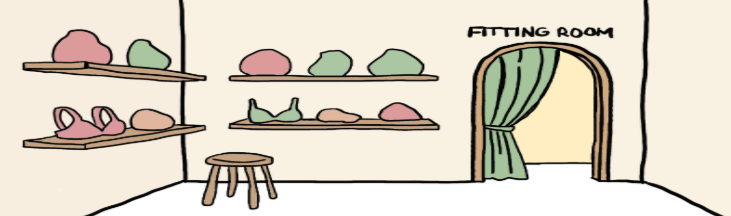
I chose a banner image that would show the inside of a prosthetic fitting studio, with the shelves of bras and silicone prosthetics leading toward a private fitting room. At first glance, the space looks like a small retail shop. Understanding its purpose reveals something deeper: a place where people regain confidence after major medical changes.
The image reinforces what I learned: good design is not only about the objects we create, but also about the care and relationships surrounding them.