What
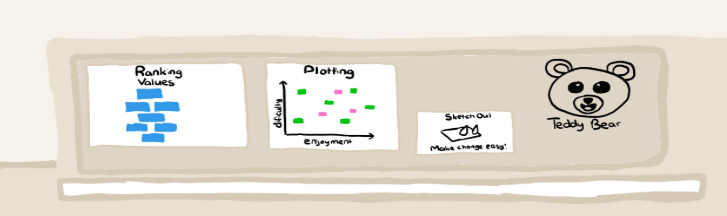
on contained three different activities: a plot diagram mapping their overall thoughts of values of their daily work, a ranking exercise to surface priorities, and an open ideation activity where Durian sketched what an ideal tool might look like. Throughout the co-design session I walked in expecting to lead, however I left having followed.
The first activity was the plot diagram, we asked Durian to rate tasks across two axes: enjoyment and difficulty. I had anticipated that clinical tasks like lab work or post-appointment documentation would rank low, while patient interaction would rank high. Durian confirmed my beliefs, but what surprised me was the amount of nuance underneath. Fitting patients, Durian noted, was both the hardest and the most loved part of the job. "It's hard…physical…but I love it a lot," they said, adding that patients "care about loving the brace." That phrase stopped me. It reframed the entire design challenge: we were not just designing a tracking tool. We were designing something that had to honor an emotional relationship between a practitioner and a child wearing a piece of equipment on their body.
Once we moved into the ideation activity, things grew even more unexpected. Durian lit up seeing our sketch design of a bear with a prosthetic companion for pediatric patients. Mentioning that the bear will help make kids feel special and excited, additionally noting that it's good for children's mental health. I had prepared for critique of measurement accuracy and scheduling workflows. Instead, Durian was advocating for the emotional experience of a child in a long appointment, noting that a build-your-own prosthetic game could "help for longer appointments." By the time Alex sketched their own ideal tool, with in-lab cone smoothness adjustment and faster-drying glue to cut waiting time, I understood that I had entered this session carrying assumptions I did not know I had.
This finding was shocking, as I had assumed prosthetic products aimed for perfection in terms of symmetry. She did explain that her clients' bodies after surgery are not symmetrical; as doctors leave different amounts of tissue, and patients have had different types of procedures. The fitting process involves trying several prosthetics and testing bras until the client feels comfortable. She mentioned that she makes the clients try to move around a lot to make sure it is fully comfortable for them.
So What
What this experience taught me is that prosthetists' jobs don't solely live on technical knowledge, it lives on emotional knowledge as well. Durian's response to the bear concept was not a soft aside; it was a design specification. The moment I recognized that, my entire orientation shifted. I stopped thinking of myself as the designer receiving input and started thinking of Durian as a designer alongside me.
The reason why this matters is that, as we are designers we often enter co-design sessions with quiet confidence in our own frameworks. We have done the research, built the activities, and believe we know what questions to ask. But a structured activity like the plot diagram can reveal dimensions of a problem that no prior research would surface: in this case, that the hardest job task is also the most beloved, and that this paradox is the very core of what we are designing for.
The lesson I want to pass on to future CD students is this: the most important thing your co-design partner says may not be in response to your best question. It may arrive as a throwaway comment, "good for children's mental health", while they are sketching something else entirely. Listen for what surprises you, not just what confirms your frame.
Now What
For the future, I will make sure to approach every co-design session not as a data collection exercise but as a negotiation of expertise. The primary goal of the session is not to extract information, rather it is to create the conditions under which someone else can show me what I cannot yet see. Practically, this means slowing down when a participant says something unexpected, and resisting the urge to move on to the next prompt. That moment of surprise is the data.
This lesson generalizes beyond just our group of certified prostheticists. Any time a designer works with a practitioner, they are entering a space where that person has integrated technical and emotional knowledge over years of lived practice. A software team building a scheduling tool for nurses might design for efficiency and entirely overlook the relational rituals embedded in a shift handoff. The emotional architecture of a job is not decorative, it is structural.
That said, this lesson has its limits. Not every co-design partner will be as expressive as Durian. Some participants are guarded; some institutional contexts suppress that kind of disclosure. And in a large-scale service design, you cannot co-design with every stakeholder.
Looks Like
The banner image I chose shows the things our team brought to our co-design: sticky notes for value ranking, the graph of enjoyment and difficulty of tasks, a rough sketch of a bear figure. The image is intentionally busy and unpolished, because that texture is the point.
A co-design session does not look clean, it looks like controlled chaos with materials overlapping, ideas half-formed, conversations veering off script. What I want a future student to notice when they look at this image is the hand. Not the researcher's hand. The participant's. The person doing the drawing is Durian. The designer at this moment is not me. That is the whole lesson in one image.