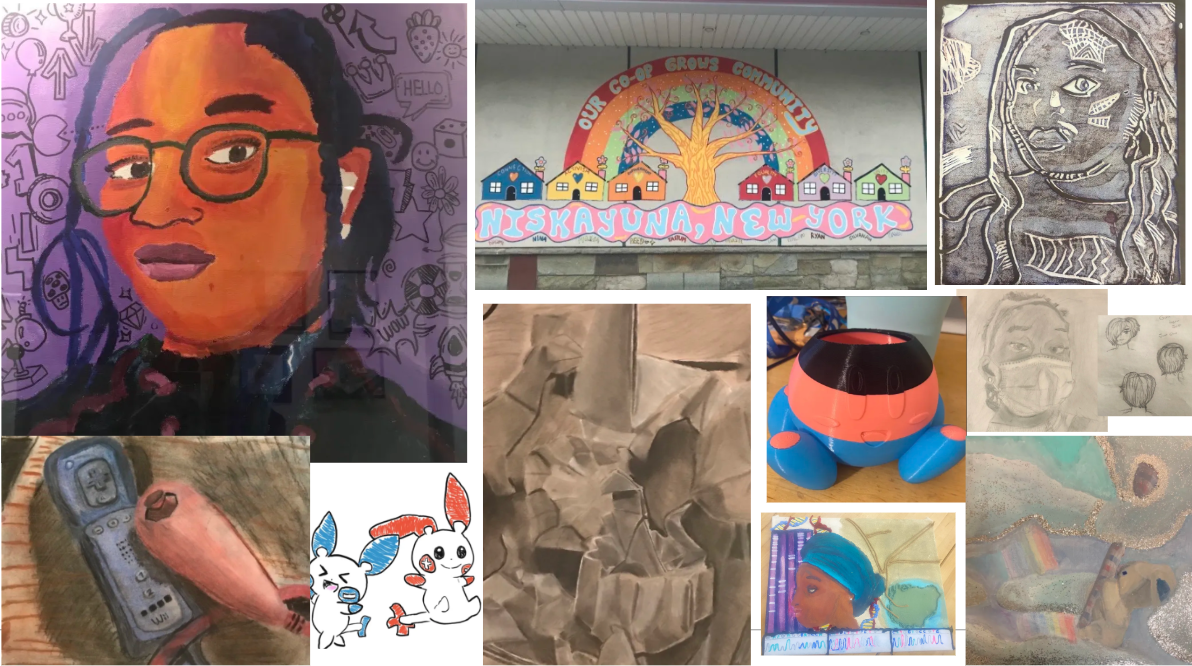
Art was always my first language. Long before I knew what a semicolon meant in a line of code, I knew the weight of a carving tool in my hand. To this day I can still hear the rhythmic shuck-shuck of gouging into a linoleum block in my middle school art room: the smell of thick, tacky ink and that breathless moment of peeling back the paper to reveal a block print. It was a world I had mirrored, carved, and pressed into existence.
Art has held a space where color, composition, and creativity could finally breathe. It allowed me to live in my own world. That world I formed grew even more three-dimensional when I started working with clay. When I wasn't at the pottery wheel, I was hunched over sketchbooks, filling page after page with comics. I wasn't just drawing; I was world-building, weaving complex narratives where I controlled the physics, the dialogue, and the destiny of every character.
But sometimes this freedom led to indecisiveness: drifting, spacing out, getting lost in the "what-ifs" of a blank page.
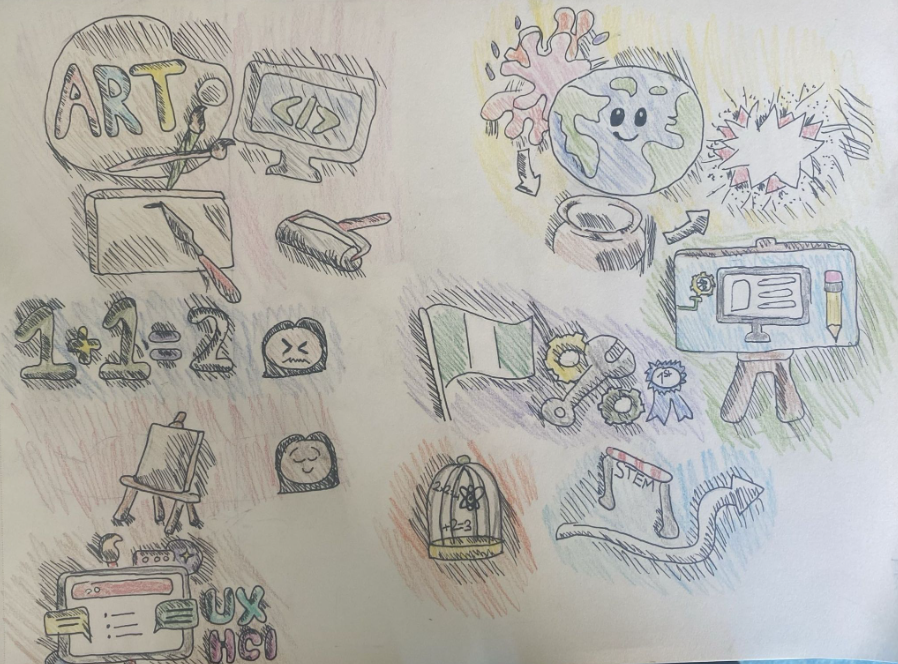
You may be asking what relevance this has to the STEM Slam? My answer is that growing up, I strongly believed that art and STEM lived on opposite sides of a vacuum.
- STEM was sterile: numbers, rigid rules, cold logic.
- Art was alive: color, chaos, limitless imagination.
If you were to ask me what I wanted to study, I'd have said art. Painting, maybe. Design, definitely. Something that made me feel alive.
But when you grow up in a Nigerian household, dreams often come with a syllabus. You can draw, sure: but as long as you're also drawing up blueprints for a future that pays. They always told me the same words “Engineering first with a stable job,” and “then you can do art on the side.”
Hearing for constant years I began to build a wall, where STEM was something I needed to have in order to survive, as its series of equations felt like cages. I didn't yet see the heartbeat inside the machine.
The wall only began to crumble as I started applying for colleges. I remember having these pivotal conversations where I was desperately looking for a "loophole", a way to be the engineer my parents wanted without losing the artist I actually was.
It started with my brother. He looked at my sketches and suggested, "Titi, what if you did UX and Research?" He described it in a way I'd never heard: as a way to map human behavior. He showed me that "data" wasn't just cold numbers and code; it was a story of how people move through the world. It was empathy, quantified.
Intrigued, I went to my art teacher. I asked her if she thought UX was just "corporate art" (was I selling out with my dream in art)? She looked at me and said, "No—it's a new medium."
Finally, I sat down with my computer science teacher to talk about bringing up the idea of Human-Computer Interaction (known as HCI for short). That's when it clicked. They showed me that code isn't just logic; it's the architecture of an experience. Writing a function isn't just about moving data; it's about creating the "physics engine" for the very worlds I used to draw in my comics.
The deeper I went, I realized that a clean block of code has the same intentionality as a clean brushstroke.
Engineering wasn't stealing art from me: it was expanding my toolkit. It was giving me a compiler and a development environment instead of just a brush and a chisel. Now, I see the world as a canvas of systems: where every algorithm is a stroke of intent and every user interface is a heartbeat.
STEM became the medium I never knew I needed to bring my imagination to life. And maybe my parents were right: not because they wanted to stop my art, but because they pushed me toward a place where I could finally engineer my own kind of art.